2.1 Explain the importance of defining target markets to the development and achievement of the marketing strategy.
Identifying a target market helps your company develop effective marketing communication strategies. A target market is a set of individuals sharing similar needs or characteristics that your company hopes to serve. These individuals are usually the end users most likely to purchase your product.
Determining Your Target Market
Although it may be time consuming up front, determining a target market allows you to focus your marketing efforts in the most cost effective way possible. Begin by clearly defining your product or service and then defining the person or business that will want to use what you have to offer. Understanding the needs of consumers is essential. You can often discover exactly how you can meet consumer needs through careful market research including running a focus group, scanning industry reviews or doing a market survey.
Craft Specific Messages
Once you have identified a target market you can craft messages that appeal specifically to them. As an example, an interior decorator can tailor and market their services to a wide range of prospective clients. The marketing message will need to be designed to attract either the high-end home owner looking for an expensive make-over or the senior citizen looking to downsize while still retaining some of their prized possessions. The needs are very different so each marketing message must be crafted to reflect how each need will be met.
Focus on Potential
Organizations don’t have the time or resources to be able to reach everyone with a product message. Identifying a target market allows marketers to focus on those most likely to purchase the product. Limiting the population funnels research and budgets to the customers with the highest profit potential.
Reach the Right Audience
Once you’ve identified the target market, consider the target audience — the intended recipient of your advertising message. Many times the buyer of your product may not be the same as the end-user so your message needs to be tailored to the person making the purchases. For example, everyone in the home benefits from laundry detergent, but it is most frequently purchased by women who buy the family’s groceries. For that reason, soap commercials traditionally target moms who want their family in clean clothes.
This strategy is sometimes skewed however. When it comes to toys, kids are the big end users, so it might be more effective to market directly to them. Even though it is their parents who buy the toys, kids are big influencers of how their parents spend money in this area. Messages marketed to kids can drive them to persuade their parents to make purchases on their behalf.
Identify an Under-served Market
Businesses of any size can compete effectively by identifying under-served markets. Rather than trying to reach every customer who could use your product, focusing a marketing plan to fit a smaller and possibly unreached part of the total market can allow you to carve out a niche for your product. By focusing resources on a specific customer segment, a small business may be able to better serve a smaller segment of the market than its larger competitors.
Cost-effective Strategies
Once you know who you are targeting, it is much easier to make decisions on media allocations. If your target market is young women, rather than purchase ad space in every magazine., you can advertise only in those popular with that audience. You’ll save money and get a better return on investment by using a target market plan. Media buys will be more efficient as wasted audience — those unlikely to purchase your product — is greatly reduced.
2.2 Explain how target markets are established for marketing activities.
Target marketing could be a great way for your business to effectively put your desired message in front of the right consumers. The three main target marketing activities include segmenting, targeting and positioning. These activities aim to identify a profitable customer base, or target market, and develop marketing campaigns optimized for those consumers. Target marketing is also known as STP marketing.
How Target Marketing Works
Target marketing aims to optimize advertising expenses by identifying the most profitable groups in the consumer base, a research task known as “segmenting.” The “targeting” phase identifies the most effective media for reaching the target segment. The “positioning” activity is one of appealing to the target segment’s shared values to produce effective marketing content. Successful target marketing is more cost effective than shooting blind as it engages target customers with messaging that appeals to their values.
Segmenting
Segmenting divides the overall consumer base into groups by type of customer. For example, segments devised by an athletic shoe manufacturer might include: competitive athletes, non-competitive fitness customers and shoe-wearers not interested in athletic shoes. Segmenting further divides those customer groups by geography, lifestyle, age, gender, income and other demographics. These segments are later used in the “targeting” process for marketing efforts.
Targeting
Target marketers analyze the full array of market segments to choose their target audience or target segments: the groups most likely to consider buying a particular product. Marketers might identify a single segment, or might target multiple segments. The goal of the targeting phase is to identify combination of potential customers presents the strongest profit potential. For example, a targeting decision might chose an older demographic for its disposable income or a younger demographic for the opportunity to build a longer-lasting brand loyalty.
Positioning
In marketing, the term “positioning” refers not to physical location, but the location in the market relative to other offerings. Said another way, positioning is the act of presenting a desired impression to the consumer base. Examples include positioning a product as the highest quality, lowest price, best value or most sustainable. The key to positioning is not to fight a competitor for the same superlative but to identify an unchallenged market identity and fill that role.
Another Example
The target marketing process for a hypothetical new computer brand would start by identifying the segments that have unsatisfied computer needs, say, lower cost or more powerful technology. The process then moves to choosing the most profitable combination of segments to target with marketing for this new computer brand. Finally, the new computer brand is positioned in the market as the solution to consumers’ unsatisfied computer need: “now more affordable” or “now more powerful.”
2.3 Describe how digital marketing techniques appeal to different market segments.
Marketing often draws on the concepts of segmentation, targeting and positioning (STP) in order to understand and direct marketing activities. And while this classic triple-threat combination is useful in a wide array of marketing activities, it’s important to note that user segmentation and market segmentation are applied in somewhat different ways in the digital customer journey than the traditional journey.
Marketers are always trying to convey the appropriate message to the right group, but in digital marketing, it’s more difficult to assess buyer behaviour and understand their journey and therefore it’s harder to segment your audience and target your message.
What is the Buyer Persona?
You’ve probably heard the term “buyer persona” floating around in business and marketing circles and may have wondered what it was. A buyer persona is a description of your ideal customer. Creating a few different buyer personas can help you understand your audience better in order to target lead and sales strategies and segment your audience.
When creating a buyer persona template, you’ll want to essentially visualize whom the people are to most likely purchase your goods and services. Here are some questions to consider as you build some personas of your ideal customer:
- What do they do?
- How old are they?
- What are their hobbies?
- What is their salary?
- Where do they live?
- What are their short and long-term goals?
The point of this exercise is to understand different ways that you can approach them with a message that lets them know you can help them achieve what they want or need.
What is Audience Segmentation?
Audience segmentation is when you divide your audience into different groups based on various criteria, such as demographics and media use. Digital marketers segment audiences as key part of a targeted marketing strategy.
Audience segmentation is crucial in the digital sphere because consumers are more empowered than ever. Not only that, they are making purchasing decisions at a faster rate than ever before. So, the challenge for digital marketers is to understand how to catch them in the process of the buying decision – to do this, they need to do everything they can to understand the way their audience thinks and behaves.
If you’re wondering about where to start when it comes to audience segmentation, here are a few key areas to think about.
Past Purchasing Behaviour
You want to segment your previous buyers out from new buyers, as you will be engaging differently with different sets of people based on the relationships you have already built. To this end, your segments can be differentiated based on buying patterns and even the types of products they’re purchasing. The key will be to anticipate their future needs so that you can show them what they need before they even really realize it.
Key Social Channels
Understanding how and where people are consuming your content can go a long way towards how you market your goods and services to a different audience. It can tell you about the types of things they prefer as well as how they interact with their friends. There are also plenty of ways you can use your social channels to target, so the two go hand-in-hand in various ways when you are working on a strategy.
Psychographic / Lifestyle Segmentation
Sometimes people segment their audience according to particular traits, cultural values, or lifestyles. These can also be related to current events. This kind of segmentation can be difficult to pinpoint because it’s not always in the form of concrete information like geographic segmentation or age, which are clear and concrete sets of data. It may be more about values, preferences or lifestyle factors. Psychographics requires that marketers dig a little deeper. To this end, things like Facebook polls and quizzes can work wonders.
Targeting
Once you’ve segmented your audience into the appropriate groups, you’ll then look into the best ways to focus on the different groups and catch their attention via marketing campaigns. You’re going to be building this based on their demographic characteristics – and their demographics and buyer persona are going to give you clues about the types of things they value.
Once you’ve delivered effective messaging, you’re going to want to understand how to address and retain both the customers that have already engaged (for instance, through customer loyalty programs) as well as how to address the customers that didn’t follow through to make a purchase.
Retargeting
Understanding why people made the decision not to open an email or stay on your website can provide valuable clues. To this end, remarketing or retargeting techniques can help. Remarketing techniques usually use cookies to track your audiences and see what they’re doing once they’re off your site. The cookie helps to keep your targeted ads running to people who have already visited your site but have left.
Retargeting is best used as part of a broad-based strategy and is not appropriate for all sizes of business. Use it with both inbound and outbound content marketing strategies to help with conversions across multiple platforms. Note that you’ll need to understand what’s driving your traffic first before implementing retargeting programs – this isn’t a way to bring traffic.
All of this boils down to not only solid customer engagement in a real-time way, but basically data. Are your customers human beings that should be addressed this way? Absolutely. But they are also full of information that can help you to form and refine your strategy in order to move into better STP activities in the future.
Offer Unique Experiences
You can use social channels in various ways to offer customers unique experiences in order to build brand awareness and better engagement with specific initiatives and products. Engaging in real time can help you understand their buying habits and journey. So, when you’re offering them an interesting experience at different phases, you are able to find a greater depth of information and they can learn more about you too.
This can take the form of events, contests, discounts – whatever suits your brand story and offers something of value to the customer. Something as simple as a hashtag can actually work wonders when it comes to real-time interaction using social media.Red Bull’s #putacanonit is a great example of a hashtag campaign that was inspired by someone’s photo.
2.4 Explain how digital marketing contributes to market segmentation.
How Digital Marketing is Redefining Customer Segmentation
Classic Customer Segmentation
Readers of this blog know that we are strong proponents for keeping business acumen skills simple and applicable. Last week, we questioned why so many so-called experts make business strategy so complicated when there are a few very simple and effective tools to use to develop and execute strategy.
Most business and marketing professionals follow one of four classics segmentation techniques.
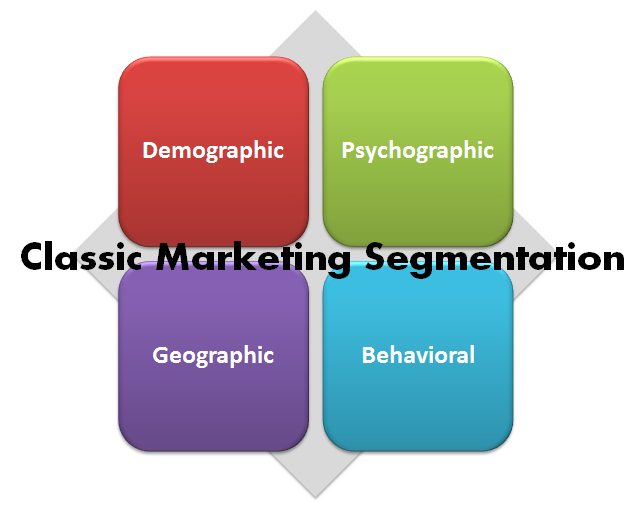
Demographic segmentation is defined as segmenting your potential market by the way the market is composed from people perspective. Age, gender, sexual orientation, and income are just a few ways of creating a demographic segmentation approach.
Geographic segmentation is defined as segmenting your potential market by where they are located. North American, US, Northeast US, New York, New York City, and Zip Code 10001 are just a few ways of creating a geographic segmentation approach.
Psychographic segmentation is defined as segmenting your potential market by customer personality traits, values, attitudes, interests, and lifestyles. Within a few hours of the Supreme Court’s decision to legalize same-sex marriage, proactive marketers started running ads and social marketing appealing to lifestyle segments that support same-sex marriage and potentially will purchase their products.

Behavioral segmentation is defined as segmenting your potential market by the behaviors of different customer types. Advantexe Learning Solutions utilizes a behavioral-based segmentation approach in most of our business simulations. For example, our core global business simulation AGES segments customers in different regions and markets by Cost Conscious Customers, Solution Oriented Customers, and Sophisticated Customers.
Segmentation in the Digital Age
In classic marketing, customers are segmented into groups with like buying patterns. Marketers focus on trying to deliver the right message to that group of customers and hope for the best.
In digital marketing, no two customers are exactly the same; there is no clumping, grouping, or general assumptions about what makes buyers buy. That is the core and central theme of personalized digital marketing. And just like how execution is the driver for classical marketing, execution of personalized digital marketing is even more important. Emerging digital marketing companies are developing tools, platforms, and strategies that enable retailers and brand leaders to reach their potential customers by using mobile technologies. Each “touch” to a potential customer is customized and based on a unique set of preferences that can be accelerated in the moment.
As we were thinking about this evolution of segmentation strategy, it occurred to us that this “in-the-moment digital catalyst approach” still has some foundation in classic marketing, but with a few dramatic name changes.
I present a new way of thinking about customer segmentation in the digital age:
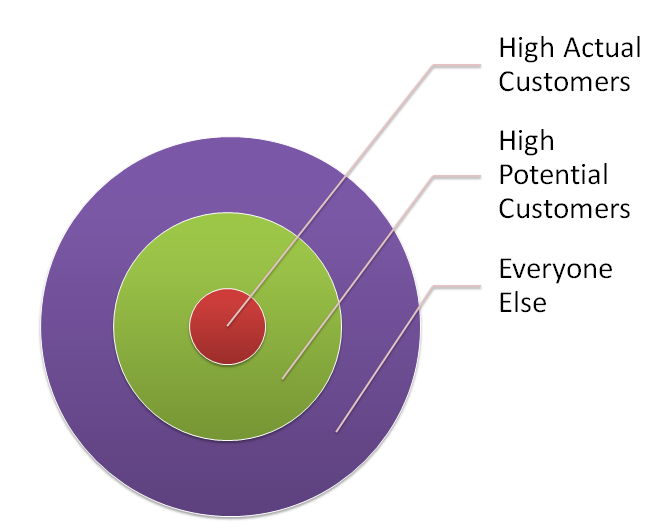
The High Actual Customer Segmentation is a segment that wants to buy, has made a decision to buy, but hasn’t decided which brand to buy from yet. Customized and personal digital marketing is the perfect solution for this customer segment.
The Potential Customer Segmentation is a segment that has thought about buying, but hasn’t had the full reason or desire to yet. Customized and personal digital marketing is a great tool for this segment because some sort of additional value proposition like a coupon or one-time discount can be the deciding factor that turns the potential customer into an actual customer.
2.5 Evaluate data to inform market segmentation
Market segmentation: basic strategies to identify segments and select a target market
As people and communities grow more diverse, it becomes risky for an organization to offer the same marketing mix to such different consumers. Market segmentation provides businesses with the possibility of customizing a unique set of elements known as the 4P’s (product, price, place, and promotion) for specific target markets. Therefore, it allows them to satisfy their customers’ needs in a more effective way; through a value proposition that is potentially superior to that of any other competitor. Market segmentation refers then to the process of defining and breaking down a wide market into clearly identifiable and homogeneous groups of consumers with similar characteristics, wants, and needs.
Few organizations are big enough to satisfy the needs of an entire market. Most companies are forced to split the total demand into several segments and select only those that they are best equipped to handle.

Experts suggest that a market segment should be:
- Easily and clearly identifiable
- Measurable
- Accessible by promotion, communication and distribution channels
- Different in its response to a marketing mix
- Stable (not changing too quickly)
- Appropriate for the company’s policies and resources
- Substantial enough to be profitable
The basis for segmentation is a factor that varies among the groups of a certain market, but is consistent within each group. All markets can be broken down in different ways, and although many of the bases used to segment a consumer market can also be applied to businesses and organizations, the sheer nature of these eventually leads to other specific segmentation bases.
The identified segments are profiled and the attractiveness of each one must be evaluated before choosing a target market. However, a question that stands after selecting the criteria to break down the market is: what methodologies are followed to build up a segment in the first place?
There are rigorous analytic techniques used to organize consumers into groups with related needs, wants, and attitudes. With these, the size and potential market of each segment can be determined, along with the positioning and the appeal that will be used to cover it. For example, a K-Means Cluster Analysis attempts to identify relatively similar groups of interviewees based on selected characteristics using an algorithm capable of handling large amounts of people. Essentially, this method tries to separate n observations into k clusters, and each observation belongs to the cluster with the closest mean.
A very well-known industry in which this sort of analysis is frequently used is the mobile telecommunications industry, where competition is becoming stronger around the globe. Customers are demanding a higher quality at a lower price, and carriers’ profits and average revenue per user are facing tremendous challenges. In this case, the aim of clustering is to categorize prospective customers into unique groups for distinctive contact strategies and new offerings, by managing billing system data and information. This data, along with call records, describe customer utilization and spending behavior, allowing operators to approach customers in a more effective way. China Mobile Limited, the largest mobile carrier in the world with over 600 million subscribers, is well known for using this analytic technique.
Apart from playing a major role in developing new marketing efforts to attract new customers, market segmentation can also help a business to discover ways to reinforce existing customer loyalty. For instance, a firm may request some kind of feedback through questions specifically addressed to a certain group with the purpose of obtaining practical suggestions on how to make a product better. The customer will then know that the company is truly aware and the bonds between them will grow stronger.
 Digital Marketing Level 4